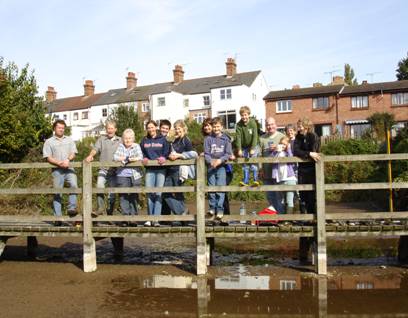
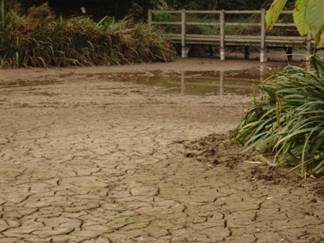
No sooner had we become accustomed to a dried up Mere, the heavens opened and back came the water. Many people asked where the water had gone as though the WWA were responsible for ‘pulling the plug’ but we explained it was due to circumstances beyond our control! The main reason for the drying-out of the lake was because of low rainfall in recent years, and the shallow flow of the river Ver throughout the summer months meant that little water was entering the Reserve. The water table has been dropping rapidly and this was the most dramatic sign of how bad the situation had become. The last time the Mere dried out was in 1997 but this was followed by severe flooding in 2000 – so go and buy your wellies now!
One benefit of the Mere drying out has been the reduction in Mallard numbers – one of the aims of the Association is to try and improve the variety of wildfowl on the Reserve. The Mallard population is around twenty birds at present. A strict ‘No Feeding’ publicity campaign will continue over the winter along with ongoing publicity about why we are doing this. Mallards are aggressive birds and tend to frighten away other species. A pair of Gadwall visited earlier in the year and it would be wonderful to have them back again along with some Teal or Tufted ducks. Too many waterfowl pollute the water and make it difficult to introduce new aquatic plants, as they always end up being eaten by the ducks. We want quality, not quantity, of birds!
It was great to see such a good turnout of volunteers at our October working party. Much was accomplished, including cutting back brambles, clearing a space for the Wassail event in January, picking fruit for jam making, and general Reserve maintenance. Who needs the gym when you can have a workout for free – and all in the glorious autumn sunshine!
One outstanding but fairly urgent job that never seems to get done at working parties is sanding down and weatherproofing the three benches that are dotted around the Reserve. If there is anyone ‘out there’ in our Membership who could adopt a bench and give it some much-needed TLC please contact the Site Manager who will rush some sandpaper, a brush and some Cuprinol to you, post haste!! Let’s allow our visitors to sit in style this forthcoming year……
Thanks are due to
Audrey Cowan who has offered to tend the new hedge this year until it becomes
established. Also, thanks go to Jack Hill for helping with filling the bird
feeders and trying to make the bridges vandal proof.
And it goes without saying that all our helpers
are greatly appreciated, whether as a one – off visit or on a regular basis.
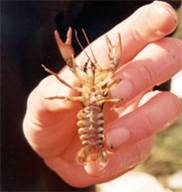
The native crayfish: The British Isles has a single species of native freshwater crayfish; the white-clawed crayfish (Austropotamobious pallipes). Naturally, it has a wide distribution here, but tends to be confined to areas with relatively hard, alkaline water with chalk or limestone bedrock. In the past the Ver had a large and healthy population of these interesting crustaceans. It occupies a range of habitats including streams, rivers, lakes, reservoirs and water-filled quarries. It prefers streams and rivers without too much sediment; it is sensitive to biocides and other pollutants. Shelter is important for its survival e.g. rocks/stones, tree roots or a bank into which it can burrow. It is omnivorous, feeding on a wide range of animal and vegetable matter. It is eaten by certain fish (perch, carp, trout, chub, pike and eel) as well as birds, rats, mink and otters. The young also fall victim to carnivorous insect larvae and nymphs. White-clawed crayfish eggs hatch in June. The female has been carrying them around since mating the previous October, attached to the underside of her abdomen, where she fans water over them with her tail. The newly hatched larvae, each as large as the head of a drawing pin, stay with her for the first few weeks of their lives. It takes 3-4 years for the young to mature. Once adults, crayfish moult once a year.
Introduced species: Other crayfish species have been artificially introduced into the British Isles, although self-sustaining populations were not identified until the 1970s. In that decade large quantities of the narrow-clawed (Turkish) crayfish were introduced for the restaurant trade. Some escaped from fish markets and others were deliberately introduced into the wild. Expanding populations are now known in and around London, particularly in the Grand Union Canal, the Serpentine and Aldenham reservoir.
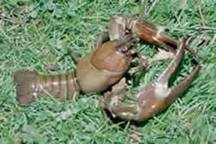
American Signal crayfish:
Also in the mid-1970s, the North
American signal crayfish was introduced into England for aquacultural trials.
This species, too, has escaped, or was deliberately introduced into the wild,
where they have largely displaced the native white-clawed crayfish in the S.E.
of England. It is a highly fertile, aggressive, invasive species. Consequently,
as it spreads into new areas, other crayfish are eliminated by exclusion and by
a disease known as crayfish plague. This is a virulent fungal disease carried
by North American crayfish, but which seem to suffer no ill effects from it.
However, native European species are highly susceptible to the disease. It is
thought that crayfish plague was introduced into Italy in 1860, where it
subsequently devastated native populations. It is thought that outbreaks did
not begin in the British Isles until the
1980s. Our native crayfish is probably now extinct in Hertfordshire; its
strongholds are the Dales and Cumbria.
The Ver is teeming with signal crayfish in the St. Albans
area; they can be seen in the river channel through Verulamium Park
and Gorhambury, for example.
[Article by Andy
Webb]
Treework
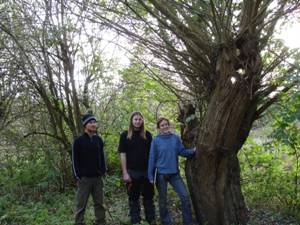
The WWA Committee has applied to the Council for
permission to do some tree work (this is a legal requirement as the Reserve is
in a Conservation area) which will involve some pollarding and pruning. We are
employing help from Earthworks for various jobs around the site and their first
task will be to pollard three old willows in the Orchard.
This part of the Reserve will be closed on the 30th November and the 1st December
for safety reasons whilst the work is being carried out.
This is money well spent and is also of benefit to their
charity. www.earthworksstalbans.co.uk
Steve, Andy(without chainsaw) and Louise from Earthworks
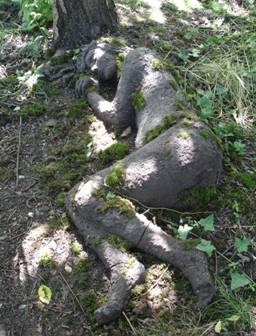 Earlier in the year, you may have been surprised to
stumble across a recumbent figure of a girl in the Shady Place. This is the work of local
artist, Catriona Maccann who very generously gave her time and talent to create
this delightful mud sculpture for us. I asked her for a few brief details about
herself and her work and a summary is printed below.
Earlier in the year, you may have been surprised to
stumble across a recumbent figure of a girl in the Shady Place. This is the work of local
artist, Catriona Maccann who very generously gave her time and talent to create
this delightful mud sculpture for us. I asked her for a few brief details about
herself and her work and a summary is printed below.
(Editor)
“I studied at Norwich School of Art and also trained in classical sculpture in
Florence. For a living I
make props and sculpture for the film industry, but my own work is mostly
figurative work in clay but I incorporate other more contemporary materials.
This time I wanted to try something new; the theory behind the mud sculpture
was to create a sculpture out of materials from the site, which would eventually
return to the site, while the stages in between would illustrate the processes
of growth, and life and death. As the plant and insect life took over until it
would gradually decay and break down as it returns to the earth. Unfortunately,
with some help it returned to the earth a little too soon, but undeterred, I'm
currently working on another piece for the WWA reserve with a small arts grant
from St. Albans Council - a Green Man (a symbol of growth and fertility, man’s
connection with nature). It is carved from a piece of apple wood, (to go into
the Orchard,) to tie in with the annual Wassail celebrations in January.”
Unfortunately, Catriona’s work was vandalised during the school holidays
but I know many people gained a great deal of pleasure from seeing the figure
before her early demise!
Catriona sent me this photo of work in progress of
the ‘Green Man’.
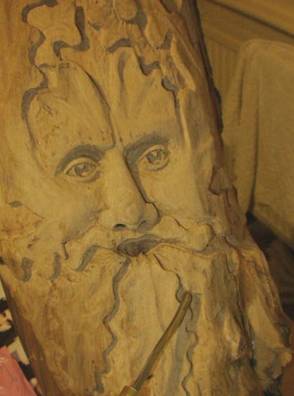
And pictured below is an earlier version made from the
excess mud that Catriona didn’t need!
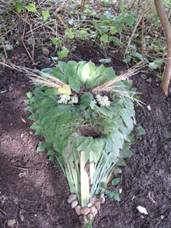 Well done to a visiting art group who
made this just for a bit of fun! Perhaps this will start a trend for
spontaneous art work around the Reserve? Wassails, Green Men - whatever
next?
Well done to a visiting art group who
made this just for a bit of fun! Perhaps this will start a trend for
spontaneous art work around the Reserve? Wassails, Green Men - whatever
next?
Perhaps a Tree Dressing Day next year …….…any volunteers?
Wassail January 2006
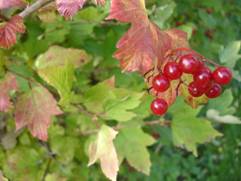 The Wassail is proving to be so popular that the Committee has decided
to make it a proper fund raising event in aid of a local charity. It will be
held on Saturday 14 January 2006 starting promptly at 2.00pm.
The Wassail is proving to be so popular that the Committee has decided
to make it a proper fund raising event in aid of a local charity. It will be
held on Saturday 14 January 2006 starting promptly at 2.00pm.
There will be music, songs and possibly dancing, along with hot drinks and
apple-based snacks made with fruit from our Orchard.
There will be no entry fee
but a donation for the refreshments would be appreciated! Once again, there
will be a selection of Derryn and Sheila’s delicious
home-made jams and jellies for sale. A lot of people will put in a great deal
of effort to make this a fun afternoon and this year it would be fantastic to raise
more than last year’s sum of £220. Let’s try and
double that figure!
Sandy Glover from the St. Alban’s Mummers will once again
be leading the proceedings so come along and banish those post
Christmas blues. If anybody can help with making cakes, pies, apple turnovers,
etc, please contact the Editor who has a freezer full of peeled, cored, sliced,
blanched and puréed apples ready for turning into edible goodies!
Working parties
 There will be working parties held on the following dates:
Sunday 11 December
Sunday 8 January
As always, these start at 11am and all tools and gloves are provided.
The Footpaths Society has very generously given the WWA a cheque for £400 to use for ongoing work on the Reserve. The Committee will make sure the money is well spent on something appropriate.
WWA Cycling Section
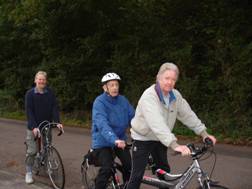
Some of the Committee members have started an impromptu ‘Alternative Cycling Group’ amongst themselves – i.e. nothing too far or too serious (pub stop optional!). Two of our WWA members are visually impaired and both are keen to have the opportunity to go out on a ride with them. One is an experienced tandem rider and the other used to be a racing cyclist and has just re-discovered the joy of cycling after 50 years, thanks to the kindness of a complete stranger (but that’s another story). Does anyone know of a tandem rider willing to spare a few hours occasionally to take these two for a spin? Offers of help or information in any way would be very welcome. The WWA committee are considering procuring two tandems (with the help of a grant) for the benefit, mostly, of our visually impaired members but this will take some time to organise, but in the meantime Roger is raring to go!! Help!
Roger (WWA) and Vince on their maiden voyage with Howard following at a safe distance!