It is with some sadness that we must say farewell to Val who has served so ably
on the WWA committee as Secretary for the last twelve years. No one will be able
to keep the committee and its affairs in order in quite the same calm and efficient
manner as Val and she will most certainly be missed by all.
We wish her well in
her new life in Berkshire where she is moving to be nearer her family. Many thanks,
Val, for your hard work and dedication, from all committee members past and present
who had the privilege to work with you.
Looking through my pile of site photographs recently, I was reminded of the transformation that has been achieved since the WWA was formed in 1991 and of the vast effort and commitment by all concerned in the subsequent years. At the time, what had previously been a market garden, watercress bed and more recently allotment gardens had deteriorated to such an extent that the three remaining allotment holders were surrounded by fly-tipping and total neglect. Local residents hatched a plan to create a wildlife and conservation area, which was eagerly accepted by St Albans District Council, and the Watercress Wildlife Association was born.
At the time I doubt that anyone appreciated just how much work would be involved. Everyone seemed keen to volunteer and get involved in any possible way, contributing to an exciting and positive community project. Ten years and several prestigious awards later, all that effort was justly rewarded by official designation as a Local Nature Reserve, with praise from all quarters. Many of the original members have moved on, but the Association has continued to flourish with a steadily increasing membership.
Recent years have seen continual changes in the WWA. The management committee in particular has now less than half the original number of members and is in danger of becoming a victim of its own success. Apart from running and maintaining the site, there have been site events, involvement with other conservation groups, a regular newsletter (improving every year) and the creation of a dedicated website. The committee is an informal and friendly group of like- minded people, but reducing numbers means that we are actively looking for new recruits willing to spare a few hours a month helping with the general administration and organisation.
Without additional help future plans and proposals will have to be cut or abandoned as individuals are being asked to take on increasing responsibilities. No particular qualifications or experience are necessary, just an interest in conservation and community involvement. If you have a secret urge to get involved, but don't particularly want to get your hands dirty, make yourself known to a current committee member at one of our regular second Sunday mornings on site, or contact me via our website.
I would also like to make an appeal for contributions to the newsletter. I have met several people visiting the site who have memories of the area as children and of the years when watercress was commercially produced on the site. Any memories or anecdotes would be very welcome additions to the site history and would be added to our expanding archive for posterity.
Steve(Chairman)
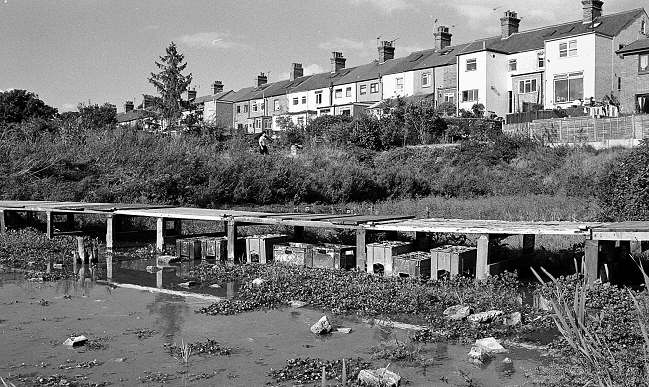
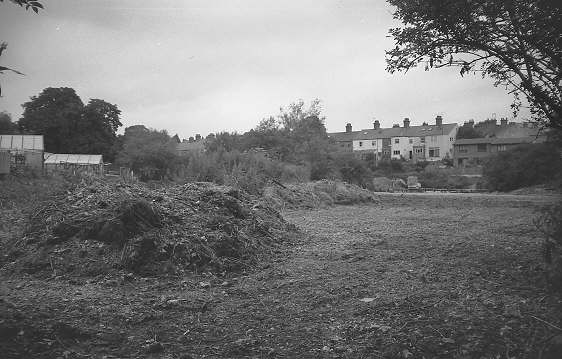
Below are 'before and after' views of the Watercress Wildlife Association reserve. We've all forgotten just how neglected the area used to look!
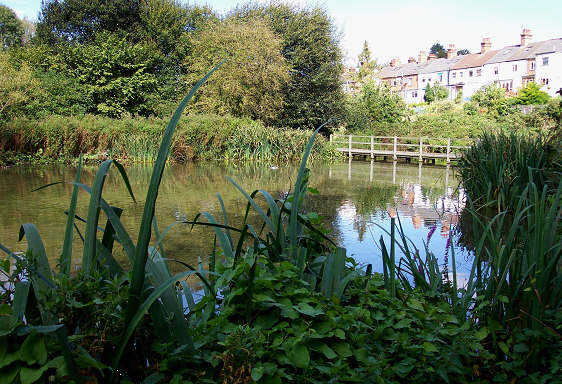
And here is that same view fourteen years later, all created by the tireless
efforts of the volunteers who come along and help - either by joining the
Association and boosting funds, by helping at work parties or by serving on the
Committee.
Thanks go to everyone who has helped transform this derelict site into
the Local Nature Reserve it is today.
The newly planted hedge is thriving even with the lack of rainfall
that we are experiencing. It will have to be pruned quite severely during the winter
months, which may seem a drastic thing to do, but it does have the effect of making
the plants thicken out from the base.
There has been yet another attempted break-in on the new shed which is becoming rather
tedious as Steve has to keep spending time on repair work. Because of continued vandalism,
the committee has temporarily put on hold any ideas about building a new bird hide
until the situation improves. If you see any incidents on the reserve, or along the
Alban Way, please report them to the new Community Police Officer (01727 796042).
The biggest job in the summer is to keep the paths clear and the grass mown
(of which there is a-plenty!) so any offers of help with this task would be greatly
appreciated. We have all the equipment necessary to do the job, so if you can spare
a few hours on a regular basis, please contact the site manager.
This summer, particularly vivid green algae appeared in the Mere and to minimise
the effect on the water quality, barley straw was added to the water. Unfortunately,
this remedy has not worked but the situation should improve as summer recedes and
when we have some decent rainfall.
After a disappointing start to the breeding season, 19 ducklings were sighted on a single day at the beginning of July. However, they all seem to have disappeared. Let's hope they haven't been taken by predators. Unusually, there have been no coot or moorhen chicks this year and the visiting pair of swans stayed for some time but they have now left without any cygnets being hatched. The site manager found a swan egg, undamaged but very smelly, in the hedge by the Sanctuary so perhaps this pair was too inexperienced to nest in an appropriate place!
A sedge warbler returned again this year and has been heard singing in the Boggy area. Nearly all the nest boxes appear to have been used with the exception of the robin box. This was moved last year to a more desirable area but 'location, location, location' must be the order of the day here. Perhaps, third time lucky!?
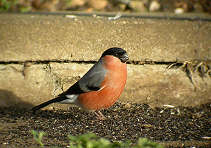
There has been a rare sighting of the brightly coloured but shy
male bullfinch. It is a dumpy, round bird with almost no visible neck. The male has
a rich red front with a distinctive black cap (the female is duller with pink-grey
underparts) and both sexes show a white rump as they fly away. It uses its round
bill to feed on soft buds, flowers and shoots rather than hard seeds. A single bullfinch
can remove 30 or more buds per minute and this is why it is considered to be a serious
pest of fruit farmers.
In the 1950s, bullfinches were trapped on a large scale and
many growers in well-wooded districts caught more than a thousand birds annually.
Their numbers had increased enormously, partly due to the decline of its main predator,
the sparrowhawk. During the nesting season the bullfinch is a woodland bird but in the
autumn it becomes more of a wanderer, feeding on seeds of herbaceous plants. In winter,
it turns to tree seeds, mainly being ash.
The hawthorn blossom made a fine backdrop to the Mere along with the yellow flag (iris) at the water's edge. The Butterfly Meadow was filled with red campion, ox-eye daisies, cow parsley and even some sweet rocket (a relic of a previous year's planting). The broom has finished flowering in the entrance and hedge woundwort is popping up around the site, especially in Shady Place. The dog roses around the site brought a welcome splash of colour at this time of year and the guelder roses were particularly stunning. Rosebay willowherb and purple loosestrife were just beginning to bloom in mid-July.
Howard found two slow worms in the 'Snake Heap' (our designated spoil heap created mainly for this purpose) proving it does work!
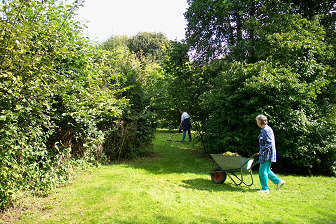
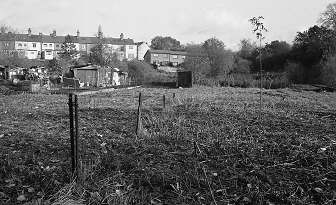
These took place on the 17th July and the WWA were pleased to be asked to man a stall at the event. There were plenty of fun activities arranged throughout the day, for adults and children alike, and the occasion gave WWA committee members a great opportunity to meet the staff , trainees and volunteers.
We are hoping that the Earthworks team can help with some of the maintenance tasks on our reserve, giving much valued work experience to their trainees.
For more about Earthworks, check out their website at: www.earthworksstalbans.co.uk
The Charity Commission have finally approved the changes to the constitution and if anyone wishes to see the finalised version, please contact the Chairman.
We have had offers of help from Jean and Alison who are now in the process of updating the website, and one of our younger members, Thorsten, is going to provide a children's page.
Steve, Howard and Sheila (from the WWA committee) and other interested parties spent an enjoyable day at Rye Meads Nature Reserve on a training session led by Alison (Water Vole Project Officer from the Herts and Middlesex Wildlife Trust). Alison gave a presentation about water voles, their habitat and the various reasons for their decline and this was followed by practical demonstrations around the reserve looking for evidence of water voles. Alison showed the group how to recognize and record the various signs of water vole presence such as droppings by the water's edge (piled into heaps or 'latrines') and remains of nibbled plants, also at the water's edge.
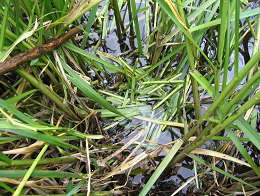
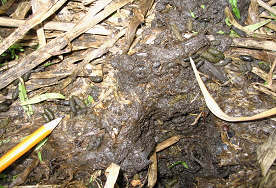
In July, Howard and Sheila helped Alison survey two stretches of the River Mimram and found a site near Welwyn (Digswell Meadows) with plenty of signs of water vole activity. Hopefully, with more practice and advice, WWA committee members will be able to monitor the WWA reserve themselves and record and send any signs of activity to the Herts Biological Centre in the future.
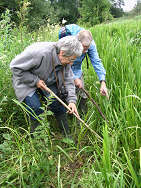 Surveying at
Digswell
Surveying at
Digswell
Sadly, Alison has not yet found any evidence of water voles on the Ver so the situation is not good at present. Alison and Sheila surveyed the river banks and ditches at Sopwell Meadows in early August but alas, there were no signs of 'Ratty' to be found there. There are still water voles on the adjacent River Colne, so one can only hope they will spread from there back to the Ver, if appropriate mink control measures are still in place.
P.S.
Don't be alarmed by the recumbent figure in Shady Place. It was created by
Catriona and a full report will appear in the Autumn newsletter.